
Is Quartz Suitable for Outdoor Use? Limitations & Alternatives
Quartz is widely used in commercial interiors, but when it comes to exterior applications, many project teams ask: is quartz suitable for outdoor use?
The short answer is that quartz is generally not recommended for outdoor environments. This article explains why, and explores better alternatives for outdoor applications.
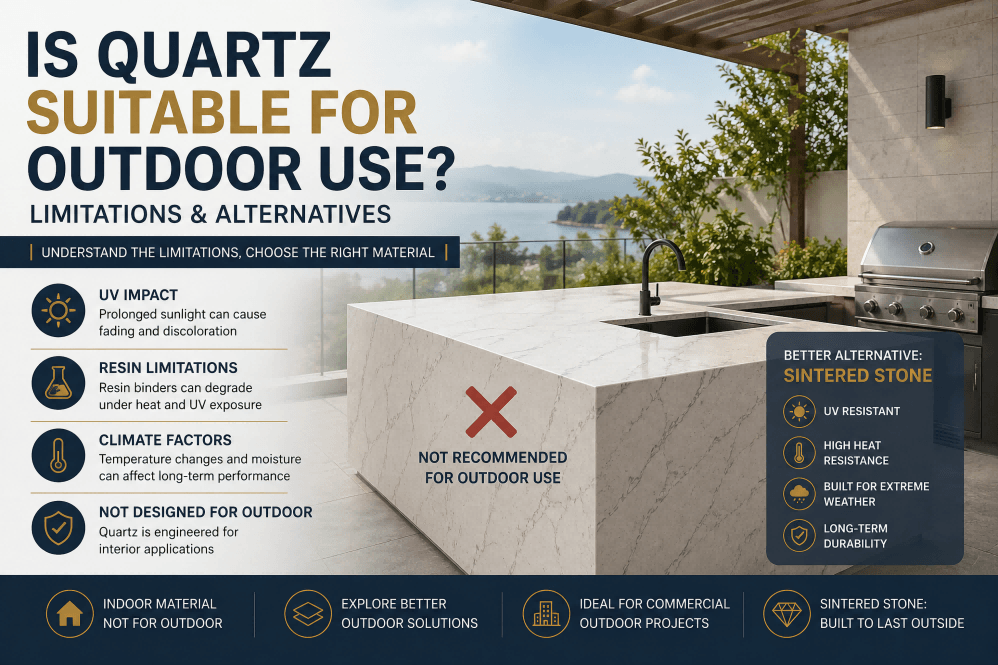
Can Quartz Be Used Outside?
Technically, quartz can be installed outdoors, but it is not designed for long-term exterior exposure.
Most manufacturers and industry professionals recommend limiting quartz to indoor use due to its material composition.
Why Quartz Is Not Suitable for Outdoor Use
The limitations of quartz outdoor use are mainly related to how the material is made.
1. UV Sensitivity
Quartz contains resin binders, which are sensitive to ultraviolet (UV) exposure.
- Prolonged sunlight can cause discoloration
- Surface fading may occur over time
- The original finish may degrade
This makes quartz unsuitable for applications exposed to direct sunlight.
2. Resin-Based Structure
Unlike fully sintered materials, quartz relies on polymer resins.
- Resin can break down under heat and UV
- Surface performance may change over time
- Long-term durability is reduced outdoors
This structural limitation is the main reason quartz is designed for interior use.
3. Climate Impact
Outdoor environments introduce variables such as:
- Temperature fluctuations
- Moisture exposure
- Direct sunlight
Quartz is not engineered to handle these conditions consistently over time.
 Check Milestone’s Quartz Stone
When Quartz Might Be Used Outdoors
In limited cases, quartz may be used in semi-covered environments:
- Indoor-outdoor transition spaces
- Covered patios with minimal sunlight
- Shaded areas with controlled exposure
However, even in these scenarios, long-term performance cannot be guaranteed.
Better Alternatives for Outdoor Applications
For exterior use, materials specifically designed for outdoor conditions are recommended.
Sintered Stone
Sintered stone is a preferred alternative for outdoor applications.
- UV resistant
- High heat resistance
- Suitable for exterior environments
- Stable under extreme conditions
👉 Check Milestone’s Sintered Stone
Natural Stone (Selective Use)
Some natural stones can be used outdoors depending on type and finish, though they require maintenance.
Quartz vs Sintered Stone for Outdoor Use
In outdoor scenarios:
- Quartz is limited by resin and UV sensitivity
- Sintered stone is engineered for extreme conditions
For long-term outdoor performance, sintered stone is generally the more reliable choice.
Choosing the Right Material for Outdoor Projects
When selecting materials for outdoor use, consider:
- Exposure to sunlight
- Temperature variation
- Maintenance expectations
- Long-term durability
Choosing the right material at the beginning prevents performance issues later.
Conclusion
Quartz is a highly effective material for indoor applications, but it is not suitable for outdoor use in most cases. Its resin-based structure and sensitivity to UV exposure limit its performance in exterior environments.
For outdoor projects, materials such as sintered stone offer better durability and long-term stability. Understanding these differences helps ensure the right material is used in the right environment.
❓ FAQ
Can quartz be used outdoors?
Quartz can be used outdoors in limited conditions, but it is generally not recommended due to UV sensitivity.
Why does quartz fade in sunlight?
Quartz contains resin, which can degrade under UV exposure, leading to discoloration.
Is quartz waterproof for outdoor use?
Quartz is non-porous, but its UV sensitivity makes it unsuitable for outdoor environments.
What is the best alternative to quartz for outdoor use?
Sintered stone is one of the best alternatives due to its UV and heat resistance.
Can quartz be used in covered outdoor areas?
It may be used in shaded or covered areas, but long-term performance is not guaranteed.