
Why Quartz Countertops Are Ideal for Multifamily Developments
Multifamily developments present very different challenges from individual residential projects.
A single apartment building may contain dozens or hundreds of kitchens and bathrooms, all requiring coordinated countertop materials. For developers, architects, contractors, and procurement teams, the challenge is not simply finding an attractive surface—it is finding a material that can be specified, repeated, fabricated, and maintained consistently across the entire project.
This is one reason quartz countertops remain a popular choice for multifamily developments.
Quartz combines design consistency, low maintenance, a broad selection of colors and patterns, and established fabrication processes, making it particularly suitable for apartment projects where repeatability and practical performance are important.
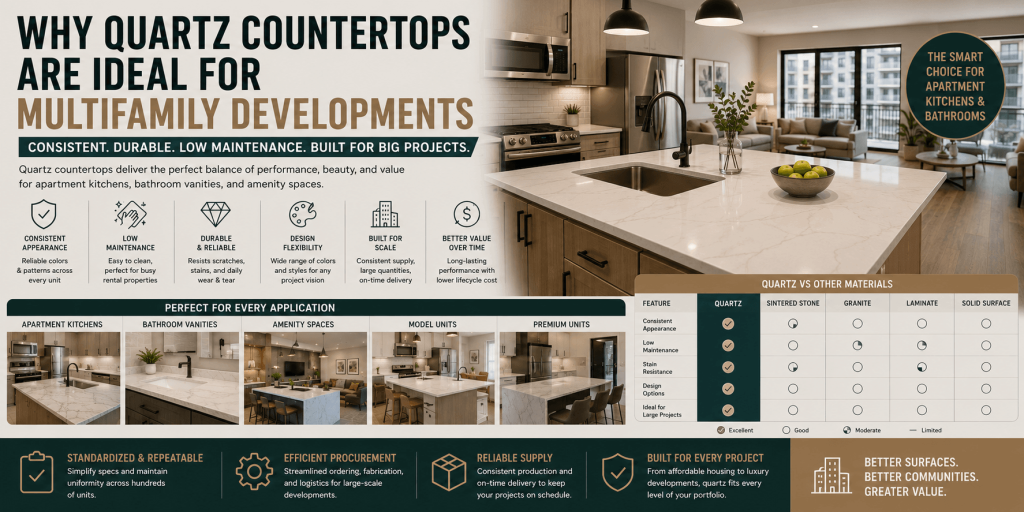
What Makes Multifamily Countertops Different?
In a single-family home, countertop selection may be based primarily on personal preference.
Multifamily developments require a much broader set of considerations.
A developer may need to coordinate:
- Multiple apartment layouts
- Large quantities of countertops
- Repeated kitchen specifications
- Bathroom vanity tops
- Model units
- Premium units
- Amenity spaces
- Future replacement requirements
This means that the material needs to work not only as a surface, but also as part of a larger project procurement strategy.
1. Consistent Appearance Across Multiple Units
One of the strongest advantages of quartz for multifamily projects is visual consistency.
When the same finish is specified across multiple apartments, developers want the finished interiors to look as consistent as possible.
Quartz is available in a wide range of:
- Colors
- Patterns
- Surface finishes
- Stone-inspired designs
- Marble-look options
This allows project teams to establish a standardized finish package that can be repeated throughout a development.
For large apartment projects, this consistency can simplify both design coordination and procurement.
2. Low-Maintenance Surfaces for Apartment Living
Apartment countertops are exposed to everyday residential use.
Kitchen surfaces may encounter:
- Food preparation
- Spills
- Coffee
- Oils
- Frequent cleaning
Bathroom vanities experience a different type of daily use, including:
- Water
- Cosmetics
- Personal-care products
- Routine cleaning
Quartz is valued for its relatively low-maintenance surface, making it a practical choice for rental properties and multifamily developments where long-term ease of care matters.
3. A Practical Choice for Rental Properties
Rental properties have a unique requirement:
The surface needs to look good not only when the apartment is first completed, but throughout repeated tenant turnover.
Between residents, property management teams may need to clean and prepare units quickly.
A low-maintenance countertop can therefore simplify:
- Unit turnover
- Routine cleaning
- Property maintenance
- Appearance management
This is especially relevant for large multifamily portfolios where maintenance requirements are multiplied across many units.
4. Wide Design Options Without Sacrificing Standardization
Developers do not necessarily want every apartment to look identical.
Instead, many projects establish a controlled design palette.
For example:
Standard Units
A neutral quartz finish can provide a clean and versatile appearance.
Premium Units
A marble-look quartz design can create a more upscale interior.
Model Units
A more distinctive quartz pattern can be used to create a stronger visual presentation.
This allows developers to create different levels of design positioning while maintaining a manageable material specification.
5. Quartz Works Well With Different Interior Styles
Another advantage of quartz is its design versatility.
It can complement:
- Modern apartments
- Contemporary interiors
- Transitional homes
- Scandinavian-inspired spaces
- Luxury multifamily developments
Quartz can also coordinate with different cabinet and flooring materials.
For example:
White Quartz + Light Oak Cabinets
creates a warm contemporary interior.
Marble-Look Quartz + Dark Cabinets
creates a more luxurious appearance.
Grey Quartz + Neutral Cabinets
creates a clean modern aesthetic.
This flexibility makes quartz suitable for a wide range of multifamily design packages.
6. Suitable for Apartment Kitchens
The kitchen is one of the most important applications for multifamily countertops.
Quartz is commonly considered for:
- Standard apartment kitchens
- Premium apartment kitchens
- Rental property kitchens
- Student housing kitchens
- Build-to-rent developments
Its combination of appearance, low maintenance, and design consistency makes it a practical option for repeated kitchen installations.
7. Quartz for Apartment Bathroom Vanities
Multifamily projects often use the same countertop material strategy across kitchens and bathrooms—or develop coordinated specifications for both.
Quartz can be used for:
- Primary bathroom vanities
- Guest bathroom vanities
- Powder room surfaces
- Apartment vanity tops
Using coordinated quartz finishes can create a consistent visual language throughout the apartment.
8. Efficient Specification for Large Projects
Large multifamily projects benefit from simplified specifications.
Instead of selecting a different material for every apartment, a developer may establish a small number of approved surfaces.
For example:
Quartz A → Standard Kitchens
Quartz B → Premium Kitchens
Quartz C → Bathroom Vanities
This approach reduces unnecessary material complexity while still providing design differentiation.
9. Easier Procurement and Repeat Ordering
Multifamily developments often involve phased construction.
A project may not require every countertop at exactly the same time.
Therefore, the ability to reorder a specified surface can become an important procurement consideration.
Quartz is widely established within the countertop industry, with familiar fabrication and installation processes.
This can make it easier for project teams to coordinate material supply with construction schedules.
10. Quartz and Multifamily Project Economics
Material price is only one component of a multifamily countertop decision.
Developers also need to consider:
- Material consistency
- Fabrication efficiency
- Installation
- Maintenance
- Replacement
- Procurement complexity
- Long-term property value
A slightly different material price may become less significant when evaluated against the total cost of delivering and maintaining a large development.
This is why quartz remains attractive for projects where predictable procurement and repeatable specifications are priorities.
Quartz for Different Multifamily Development Types
Quartz countertops can be considered across several types of residential developments.
Build-to-Rent Communities
Build-to-rent properties often need durable, visually consistent finishes that support repeated tenant turnover.
Quartz can be used in:
- Kitchens
- Bathrooms
- Clubhouses
- Leasing offices
Apartment Buildings
For conventional apartment developments, quartz can provide a standardized surface solution across multiple unit types.
Luxury Multifamily Developments
Premium quartz finishes can provide a sophisticated stone appearance while maintaining consistency across a larger project.
Student Housing
For high-turnover residential environments, easy-care surfaces can be particularly valuable.
Mixed-Use Developments
Quartz can also be specified across residential and selected common areas within mixed-use developments.
Quartz vs Other Countertop Materials
Quartz is not the only option for multifamily projects.
Depending on the application, developers may also consider:
- Sintered stone
- Engineered marble
- Solid surface
- Compact laminate
- Natural stone
Each material has a different combination of design, maintenance, procurement, and application characteristics.
For a broader comparison, see:
Best Countertop Materials for Multifamily & Apartment Projects
That article provides the wider material-selection framework, while this article focuses specifically on why quartz works well within multifamily developments.
When Should Developers Consider Quartz?
Quartz can be particularly attractive when a project prioritizes:
Consistency
Multiple units need coordinated colors and patterns.
Low Maintenance
Property managers want practical surfaces for everyday residential use.
Design Flexibility
The project requires multiple aesthetic options within a controlled material system.
Repeatability
The same specification needs to be reproduced across many apartments.
Procurement Efficiency
The development requires an established material and fabrication process.
How Developers Can Build a Quartz Specification
A successful multifamily quartz specification should define more than simply the material name.
Project teams may establish:
- Approved quartz collection
- Color
- Surface finish
- Thickness
- Edge profile
- Kitchen application
- Bathroom application
- Fabrication requirements
- Packaging requirements
Creating a clear specification early can help reduce confusion later in the procurement process.
Working With a Quartz Supplier
For larger multifamily developments, supplier capability can be just as important as the quartz itself.
Developers and contractors should evaluate whether a supplier can support:
- Large project quantities
- Consistent production
- Custom fabrication
- Multiple colors
- Repeat orders
- Project packaging
- Export logistics
- Clear communication
A supplier experienced in project-based quartz sourcing can become a valuable part of the development’s procurement process.
Conclusion
The popularity of multifamily quartz countertops is driven by more than aesthetics.
For developers and procurement teams, quartz offers a combination of:
- Consistent appearance
- Low maintenance
- Design flexibility
- Repeatable specifications
- Established fabrication processes
- Practical project sourcing
These characteristics make quartz particularly suitable for apartment kitchens, bathroom vanities, build-to-rent communities, and other multifamily applications.
The best material, however, depends on the specific project. Developers should evaluate the intended application, design positioning, maintenance requirements, procurement strategy, and overall project objectives before finalizing a countertop specification.
FAQ
Why are quartz countertops popular for multifamily developments?
Quartz is popular because it combines consistent appearance, low maintenance, design flexibility, and repeatable specifications, making it practical for projects with many residential units.
Is quartz suitable for apartment kitchens?
Yes. Quartz is commonly used for apartment kitchen countertops because it offers a wide range of designs and is relatively easy to maintain.
Can quartz be used for multifamily bathroom vanities?
Yes. Quartz is suitable for many apartment bathroom vanity applications and can provide a coordinated appearance across multiple units.
Is quartz a good choice for rental properties?
Quartz can be a practical option for rental properties because its low-maintenance surface can simplify everyday care and unit turnover.
Can developers standardize quartz across multiple apartment units?
Yes. Developers can specify the same quartz color, finish, thickness, and edge profile across multiple units to simplify design coordination and procurement.
Can multifamily projects use different quartz colors?
Yes. A project can use different quartz finishes for standard units, premium units, bathrooms, model units, or amenity spaces while maintaining an overall design strategy.
What should developers consider when sourcing quartz countertops?
Developers should consider material consistency, project quantities, fabrication capability, customization, packaging, logistics, repeat ordering, and supplier communication.
Is quartz better than other countertop materials for multifamily projects?
There is no universal best material. Quartz is particularly attractive when consistency, low maintenance, design flexibility, and repeatable procurement are priorities, while other materials may be better suited to specific applications.