
Best Countertop Materials for Multifamily & Apartment Projects
Selecting the right countertop material is an important decision in any multifamily or apartment development. Unlike a single residential project, multifamily developments may involve dozens, hundreds, or even thousands of individual kitchens, bathrooms, vanities, and common-area surfaces.
For developers, architects, contractors, and procurement teams, material selection therefore needs to go beyond appearance.
The right multifamily countertop materials should balance design, durability, maintenance, availability, consistency, and overall project value.
This guide compares the most common countertop and surface materials used in multifamily and apartment projects and explains where each option may fit best.
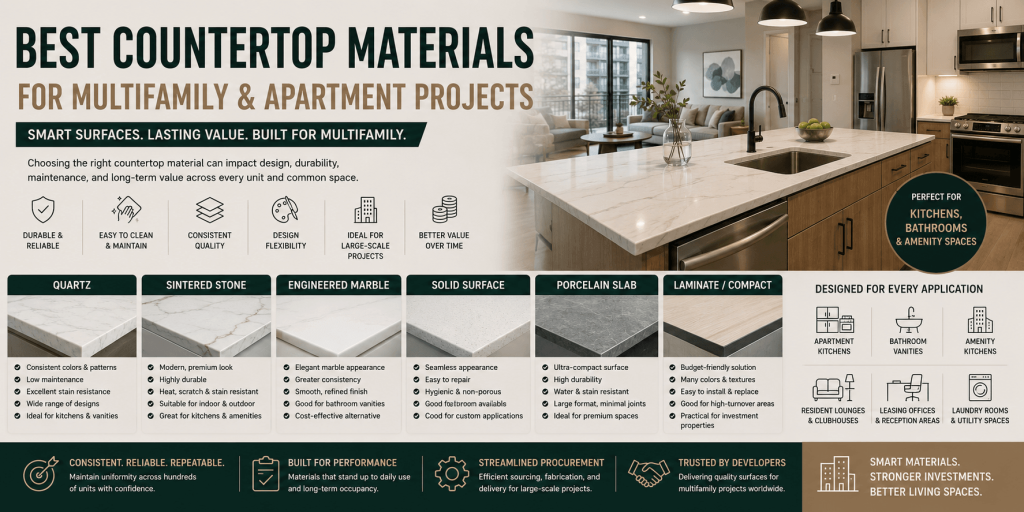
Why Countertop Material Selection Matters in Multifamily Projects
A multifamily development may contain a large number of repeated interior spaces.
For example, a typical apartment project may require surfaces for:
- Kitchen countertops
- Bathroom vanity tops
- Guest bathroom counters
- Laundry areas
- Amenity kitchens
- Clubhouse surfaces
- Leasing office areas
- Common-area hospitality spaces
Because these surfaces are repeated throughout a development, even a small material-selection decision can have a significant impact on the overall project.
Developers and procurement teams therefore typically evaluate several factors at the same time.
Key Factors for Choosing Multifamily Countertop Materials
1. Durability
Apartment surfaces experience repeated daily use.
Kitchen countertops may be exposed to:
- Food preparation
- Spills
- Hot cookware
- Cleaning
- Everyday household activities
Bathroom surfaces face different conditions, including:
- Water exposure
- Personal-care products
- Frequent cleaning
- High turnover between residents
The selected material should therefore be appropriate for the specific application.
2. Maintenance Requirements
Multifamily properties need surfaces that are relatively easy for residents, property managers, and maintenance teams to care for.
Low-maintenance surfaces can help simplify:
- Routine cleaning
- Turnover preparation
- Property maintenance
- Long-term appearance management
This becomes particularly important in rental properties where units may need to be prepared quickly between tenants.
3. Design Consistency
A multifamily development often includes many apartments with the same or similar interior specifications.
Consistent surface appearance can help create a cohesive design across the project.
For developers, this means the material should ideally offer:
- Consistent colors
- Repeatable patterns
- Reliable production
- Stable specifications
This is one area where engineered surfaces can offer an advantage over highly variable natural materials.
Quartz Countertops for Multifamily Projects
Quartz remains one of the most widely specified materials for residential and multifamily countertops.
Its popularity comes from a combination of:
- Consistent appearance
- Wide color selection
- Low maintenance
- Good stain resistance
- Established fabrication processes
Quartz is particularly suitable for indoor apartment applications.
Common uses include:
Apartment Kitchens
Quartz countertops can provide a premium appearance while remaining practical for everyday residential use.
Bathroom Vanities
The consistent appearance of quartz works well when developers need to standardize finishes across multiple apartment bathrooms.
Amenity Areas
Quartz can also be used in:
- Clubhouse kitchens
- Resident lounges
- Leasing offices
- Shared amenity spaces
For projects requiring a familiar and widely available countertop solution, quartz remains a strong option.
Sintered Stone for Multifamily Applications
Sintered stone is another increasingly attractive surface material for apartment developments.
It can provide a stone-inspired appearance while offering characteristics suited to demanding applications.
Depending on the specification, sintered stone may be considered for:
- Kitchen countertops
- Bathroom vanities
- Amenity spaces
- Selected common-area surfaces
Its design flexibility is particularly useful for projects seeking a more contemporary or premium aesthetic.
Sintered stone can also provide marble-look and other natural-stone-inspired finishes, giving designers more freedom when developing apartment interiors.
Engineered Marble for Apartment Interiors
Engineered marble is another material that can be considered for multifamily projects.
It can provide a marble-inspired appearance with greater consistency than many natural marble products.
Potential applications include:
- Bathroom vanity tops
- Residential countertops
- Hotel-style apartment bathrooms
- Decorative interior surfaces
Engineered marble can be particularly attractive when the design concept calls for a refined stone appearance without relying entirely on natural marble.
Terrazzo for Multifamily Common Areas
Terrazzo is generally less associated with standard apartment kitchen countertops, but it can play an important role in multifamily interior design.
Its strongest opportunity is often in common and amenity spaces.
For example:
- Clubhouse countertops
- Amenity bars
- Reception areas
- Shared kitchens
- Community lounges
- Feature surfaces
Terrazzo can create a distinctive visual identity that helps differentiate premium multifamily developments.
Its customizable aggregate combinations also allow designers to coordinate surfaces with the broader architectural palette.
Quartz vs Sintered Stone for Multifamily Projects
Quartz and sintered stone are often considered when a project requires engineered surfaces with a premium appearance.
The right choice depends on the application.
| Factor | Quartz | Sintered Stone |
|---|---|---|
| Indoor kitchens | Excellent | Excellent |
| Bathroom vanities | Excellent | Excellent |
| Design consistency | Excellent | Excellent |
| Color & pattern selection | Wide | Wide |
| Marble-look designs | Excellent | Excellent |
| Maintenance | Low | Low |
| Outdoor applications | More limited | More flexible |
| Premium architectural appearance | Excellent | Excellent |
For standard apartment kitchens and bathrooms, quartz may be the more familiar specification.
For projects emphasizing premium design, broader application flexibility, or stone-inspired architectural finishes, sintered stone can be an attractive alternative.
Natural Marble vs Engineered Surfaces
Natural marble remains an important material in luxury residential and hospitality design.
However, multifamily developments introduce different procurement considerations.
Natural marble may offer:
- Unique natural variation
- Premium appearance
- Authentic stone character
Engineered materials can offer:
- Greater consistency
- Repeatable specifications
- Easier procurement
- More predictable production
- Broader design control
For large-scale apartment developments, consistency can be particularly important because the same finish may need to be reproduced across many units.
Matching Materials to Different Apartment Applications
Not every surface in a multifamily project needs to use the same material.
A more effective strategy is often to select materials according to the function and positioning of each space.
Standard Apartment Kitchens
Quartz is often a practical choice when consistency, maintenance, and established fabrication are priorities.
Premium Apartment Kitchens
Quartz or sintered stone can both work well depending on the design direction and project specification.
Standard Bathroom Vanities
Quartz or engineered marble can provide practical and visually consistent solutions.
Premium Bathroom Interiors
Sintered stone or engineered marble can create a more upscale appearance.
Clubhouses and Amenity Spaces
Designers can consider:
- Quartz
- Sintered stone
- Terrazzo
- Engineered marble
The choice can depend heavily on the desired design identity.
Multifamily Countertop Materials and Project Standardization
One of the most important considerations for developers is standardization.
A project may have hundreds of apartments, but procurement teams still need to maintain control over:
- Color
- Finish
- Thickness
- Edge profile
- Fabrication
- Packaging
- Replacement materials
Standardizing the surface specification can simplify procurement and installation.
It can also make future maintenance easier because replacement materials are easier to identify and source.
Customization vs Standardization
These two concepts may appear contradictory, but successful multifamily projects often use both.
A developer may standardize:
- Material family
- Main color
- Surface finish
- Thickness
- Edge profile
while customizing:
- Unit types
- Bathroom applications
- Amenity areas
- Feature spaces
For example, a development might use one quartz color throughout standard apartment kitchens while introducing a premium sintered stone finish in the clubhouse or model unit.
This creates visual hierarchy without making procurement unnecessarily complicated.
What Developers Should Consider When Sourcing Countertops
Material selection is only one part of the procurement process.
Developers and contractors should also evaluate the supplier’s ability to support the project.
Important considerations include:
Consistent Production
Large projects require repeatable specifications across multiple production batches.
Custom Fabrication
Suppliers should be able to work with project-specific dimensions and fabrication requirements.
Color & Finish Coordination
The supplier should be able to maintain consistency between approved samples and production materials.
Packaging & Logistics
Large multifamily developments require organized delivery and packaging to reduce installation problems.
Project Communication
Clear communication between the supplier, fabricator, contractor, and design team can significantly simplify procurement.
How to Choose the Right Surface Strategy
Instead of asking:
“What is the best countertop material?”
multifamily developers should ask:
“What is the best material for each application within the project?”
This approach allows the project team to balance cost, appearance, maintenance, and performance.
A practical strategy might look like:
Standard Apartments → Quartz
Premium Units → Quartz or Sintered Stone
Bathrooms → Quartz or Engineered Marble
Clubhouse & Amenity Areas → Sintered Stone, Quartz, or Terrazzo
This creates a material hierarchy that supports both project economics and design objectives.
Final Thoughts
The best multifamily countertop materials are not necessarily the most expensive materials.
The right solution depends on the project’s scale, application, design positioning, maintenance expectations, and procurement strategy.
Quartz remains a strong choice for standardized apartment kitchens and bathrooms, while sintered stone provides additional opportunities for premium applications and architectural design.
Engineered marble can provide a refined stone appearance, while terrazzo can add distinctive character to amenity and common areas.
For developers and procurement teams, the most effective approach is to match each material to the right application rather than relying on a single surface throughout the entire development.
Related Resources
Quartz
- Quartz Stone Introduction
- Quartz Slab Collections
- Quartz Countertops
- Quartz Countertops for Commercial Projects: Performance & Design Guide
Sintered Stone
- What Is Sintered Stone? Full Material Guide
- Sintered Stone Applications in Commercial Spaces
- Sintered Stone vs Quartz for Commercial Tables & Countertops
Hospitality / Commercial Surfaces
FAQ
What are the best countertop materials for multifamily projects?
Quartz and sintered stone are among the most versatile options for multifamily projects. Engineered marble can also be suitable for selected applications, while terrazzo is often better suited to amenity and feature spaces.
Is quartz a good choice for apartment countertops?
Yes. Quartz is widely used for apartment kitchen countertops and bathroom vanities because it offers consistent appearance, low maintenance, and a wide range of design options.
Is sintered stone suitable for multifamily countertops?
Yes. Sintered stone can be used for selected multifamily kitchen, bathroom, and amenity applications depending on the project specification.
What countertop material is best for apartment bathrooms?
Quartz and engineered marble are commonly considered for apartment bathroom vanities. Sintered stone can also be specified for premium bathroom applications.
Should multifamily projects use the same countertop material throughout?
Not necessarily. Developers can standardize materials for repetitive apartment areas while using different surfaces in premium units, clubhouses, and amenity spaces.
Why is material consistency important in multifamily projects?
Multifamily developments often contain many repeated units. Consistent colors, finishes, and specifications can simplify procurement, installation, maintenance, and future replacement.
Can countertop materials be customized for apartment projects?
Yes. Depending on the supplier and material, projects can specify different colors, finishes, dimensions, thicknesses, edge profiles, and fabrication requirements.
How should developers choose countertop materials?
Developers should consider the intended application, project positioning, maintenance requirements, design goals, procurement scale, supplier capabilities, and overall project value.