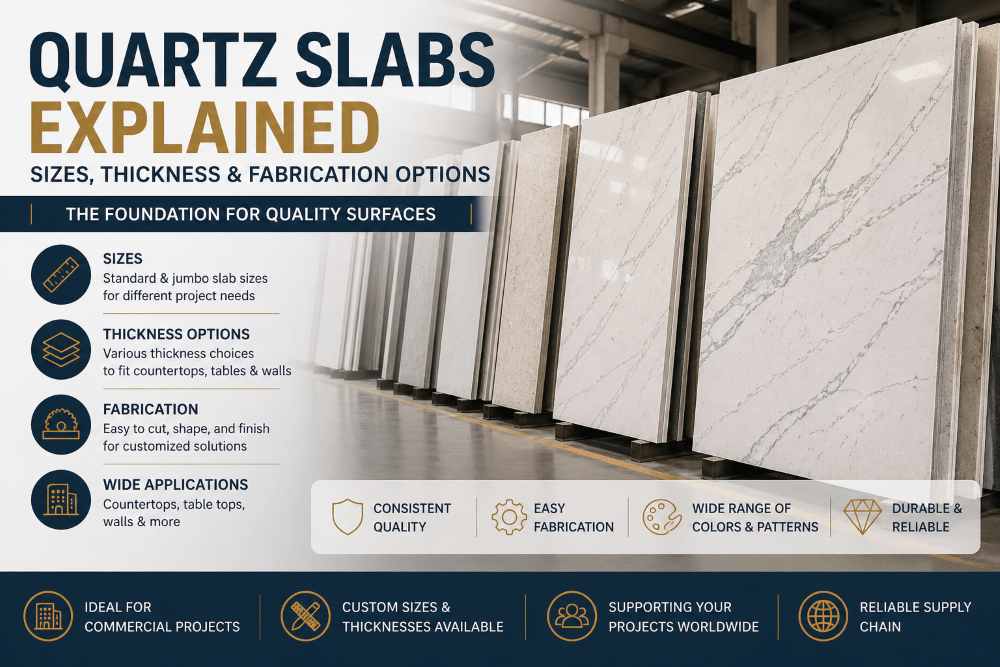
Quartz Slabs Explained: Sizes, Thickness & Fabrication Options
Quartz slabs are the starting point for a wide range of commercial surface applications. Whether used for countertops, table tops, or wall cladding, understanding quartz slab specifications is essential for proper material selection and project planning.
This guide explains standard quartz slab sizes, thickness options, and fabrication considerations for commercial projects.
What Is a Quartz Slab
A quartz slab is a large-format engineered surface made from natural quartz combined with resin and pigments. These slabs are produced under controlled conditions to ensure consistency in color, pattern, and performance.
Quartz slabs are typically processed and fabricated into finished products such as countertops, table tops, and panels.
Quartz Slab Sizes
Quartz slabs are available in different sizes depending on the manufacturer and intended use.
Standard Slab Sizes
- Standard slabs for general applications
- Jumbo slabs for large surfaces
- Custom slab sizes for specific projects
Larger slab sizes reduce the number of joints and seams, which is important for achieving a clean and continuous surface.
Check Milestone’s Quartz Slab Collections
Fabrication of Quartz Slabs
Quartz slabs are designed to be fabricated into finished products.
Fabrication Process Includes
- Cutting slabs to size
- Edge profiling
- Surface finishing
- Sink or fixture cutouts
Compared to harder materials, quartz slabs are relatively easier to fabricate, making them suitable for large-scale production.
Applications of Quartz Slabs
Quartz slabs serve as the base material for various commercial applications.
Typical Applications
- Countertops
- Table tops
- Wall cladding
- Reception desks and work surfaces
The versatility of quartz slabs allows them to be used across different commercial environments.
Check Milestone’s Quartz Countertops
Design Considerations for Quartz Slabs
When selecting quartz slabs for a project, several design factors should be considered:
- Color consistency across slabs
- Pattern alignment
- Seam placement
- Surface finish
Proper planning ensures a cohesive final result, especially in large installations.
Limitations of Quartz Slabs
While quartz slabs are versatile, there are some limitations.
Key Considerations
- Not suitable for outdoor use
- Sensitive to prolonged UV exposure
- Moderate heat resistance compared to sintered stone
Understanding these limitations helps avoid incorrect applications.
Related Reading: Quartz vs Sintered Stone
Quartz Slabs vs Other Materials
Compared to other slab materials:
- Quartz slabs offer better consistency than natural stone
- Easier to fabricate than sintered stone
- More suitable for indoor applications
Material selection should be based on performance requirements and project conditions.
Conclusion
Quartz slabs are a fundamental component in commercial surface applications. Their consistent quality, flexible fabrication, and wide range of sizes and thickness options make them a practical choice for many projects.
By understanding quartz slab specifications and limitations, project teams can make more efficient material decisions and achieve better results.
❓ FAQ
What is a quartz slab used for?
Quartz slabs are used to fabricate countertops, table tops, and wall cladding in commercial interiors.
What sizes do quartz slabs come in?
Quartz slabs are available in standard and jumbo sizes, depending on the manufacturer.
What thickness is best for quartz slabs?
Thickness depends on the application, such as countertops, tables, or wall panels.
Are quartz slabs easy to fabricate?
Yes. Quartz slabs are relatively easy to cut and process compared to harder materials.
Can quartz slabs be used outdoors?
Quartz slabs are generally not recommended for outdoor use due to UV sensitivity.
