
Quartz vs Laminate Countertops for Rental Properties
Selecting countertops for a rental property is different from choosing surfaces for a private home.
Property developers and owners need to consider not only the appearance of a countertop, but also project budget, maintenance, tenant turnover, design consistency, and long-term property value.
Two materials frequently considered for rental kitchens are quartz and laminate.
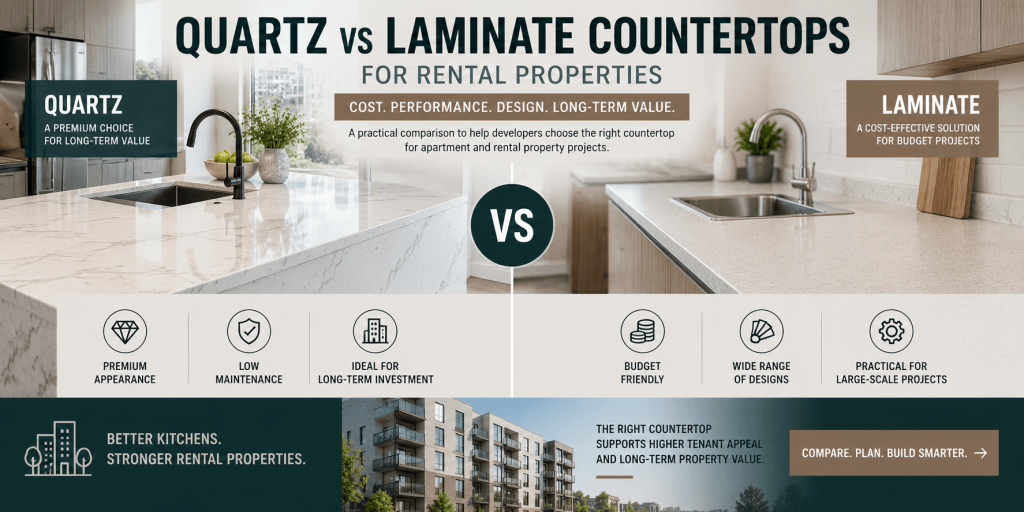
Quartz offers an engineered stone surface with a more premium appearance and strong everyday performance, while laminate provides a cost-effective solution with a wide range of decorative options.
So when comparing quartz vs laminate countertops for rental properties, which material makes more sense?
The answer depends on the positioning, budget, and long-term strategy of the property.
Why Countertop Selection Matters for Rental Properties
A rental property may need to balance two competing objectives:
Control project costs
and
Create an attractive property that appeals to tenants.
Countertops contribute directly to the appearance of a rental kitchen and can influence how the overall apartment is perceived.
At the same time, the countertop is a frequently used surface.
Rental property owners therefore need to consider:
- Initial material cost
- Everyday use
- Maintenance
- Appearance
- Unit turnover
- Design consistency
- Replacement
- Long-term property positioning
Quartz vs Laminate: What Is the Difference?
Before comparing the two materials, it is useful to understand their basic characteristics.
Quartz
Quartz countertops are engineered surfaces manufactured using mineral materials and other components.
They are available in many:
- Colors
- Patterns
- Stone-inspired designs
- Marble-look styles
- Surface finishes
Quartz is generally positioned as a more premium countertop solution.
Laminate
Laminate countertops use decorative surface layers applied to a supporting substrate.
Modern laminate can imitate:
- Stone
- Marble
- Wood
- Concrete
- Solid colors
It is widely used where affordability and design flexibility are important.
1. Initial Project Cost
For rental properties, budget is often one of the most important factors.
Laminate generally provides a lower-cost countertop solution.
This can make it attractive for:
- Entry-level apartments
- Budget rental properties
- Student housing
- Large-volume affordable developments
- Renovation projects
Quartz typically requires a higher material investment.
However, the decision should not be based solely on initial purchase price.
Developers should also consider how the material contributes to the property’s overall positioning and long-term maintenance strategy.
2. Appearance and Perceived Property Value
The kitchen is often one of the first areas prospective tenants notice.
Quartz can create a more substantial, premium appearance.
This makes it particularly attractive for:
- Luxury apartments
- Class A multifamily properties
- Premium build-to-rent communities
- High-end rental renovations
Laminate has also evolved significantly in appearance.
Modern designs can reproduce the visual character of stone, wood, and other materials.
However, quartz generally offers a more authentic stone-like visual presence.
3. Design Consistency
Consistency is important when the same countertop needs to be installed across many rental units.
Quartz is manufactured to controlled specifications, which makes it suitable for standardized project designs.
Developers can specify:
- One quartz color
- One finish
- One thickness
- One edge profile
and repeat the specification throughout a development.
Laminate can also be highly consistent, particularly when a standardized product is selected.
Therefore, both materials can support standardized rental-property design.
4. Maintenance
Rental properties require practical maintenance strategies.
A kitchen countertop may encounter:
- Food
- Coffee
- Oils
- Water
- Cleaning products
- Everyday household activity
Quartz is generally considered a low-maintenance surface.
Laminate is also relatively straightforward to clean and maintain when used appropriately.
The important difference is that the two materials have different surface characteristics and should be maintained according to the manufacturer’s recommendations.
For large rental portfolios, simple daily care can help reduce maintenance complexity.
5. Durability and Everyday Rental Use
Rental kitchens experience repeated use from different tenants over time.
The countertop therefore needs to remain functional and visually acceptable through everyday residential activity.
Quartz provides a robust engineered surface that is widely used in residential kitchens.
Laminate can also perform well in rental environments when the product is appropriately selected and used within its intended application.
The key consideration is matching the material to the expected level of use.
6. Design Flexibility
Both quartz and laminate offer significant design flexibility.
Quartz Designs
Quartz can offer:
- White stone patterns
- Grey surfaces
- Marble-look designs
- Subtle veining
- Contemporary stone aesthetics
Laminate Designs
Laminate can offer:
- Solid colors
- Wood patterns
- Stone patterns
- Concrete looks
- Decorative textures
For developers working with different property tiers, both materials provide numerous design possibilities.
7. Premium vs Budget Rental Properties
This is one of the most useful ways to evaluate the two materials.
Budget-Oriented Rental Properties
Laminate may be appropriate when the project prioritizes:
- Lower upfront cost
- Simple replacement
- Functional design
- Large-scale budget control
Mid-Market Rental Properties
Either material may be appropriate.
The decision can depend on:
- Kitchen design
- Property positioning
- Target tenant
- Development budget
- Expected renovation cycle
Premium Rental Properties
Quartz often becomes more attractive.
It can help create a more sophisticated kitchen appearance and support a higher-end interior specification.
8. Tenant Perception
Countertops are part of the visual language of an apartment.
A tenant may not know the technical difference between quartz and laminate, but they can perceive differences in:
- Surface appearance
- Texture
- Edge detailing
- Pattern quality
- Overall kitchen design
For premium rental properties, these details can contribute to the perception of quality.
For budget-focused properties, laminate may provide sufficient visual appeal without adding unnecessary material cost.
9. Replacement and Renovation
Long-term property management should be considered during initial material selection.
Rental properties may eventually require:
- Kitchen renovations
- Unit upgrades
- Countertop replacement
- Property repositioning
Laminate can be attractive when low-cost renovation is a priority.
Quartz can be attractive when the owner wants a more durable, premium surface that supports long-term property positioning.
The best choice depends on the property’s investment strategy.
10. Quartz vs Laminate for Build-to-Rent
Build-to-rent developments deserve special attention.
Unlike individual home sales, build-to-rent properties are typically managed as an ongoing real-estate asset.
Owners may therefore prioritize:
- Consistent design
- Long-term maintenance
- Tenant appeal
- Unit turnover
- Portfolio standardization
- Future renovation
Quartz can be particularly suitable for premium build-to-rent developments.
Laminate can remain attractive for projects where cost control is the dominant priority.
Quartz vs Laminate for Apartment Kitchens
For apartment kitchen applications, the decision can be summarized as follows:
| Factor | Quartz | Laminate |
|---|---|---|
| Initial cost | Higher | Lower |
| Premium appearance | Excellent | Good |
| Design selection | Wide | Very wide |
| Stone appearance | Excellent | Good |
| Maintenance | Low | Low |
| Design consistency | Excellent | Excellent |
| Everyday residential use | Excellent | Good |
| Budget flexibility | Moderate | Excellent |
| Premium rental positioning | Excellent | Moderate |
| Budget rental positioning | Moderate | Excellent |
| Long-term property positioning | Excellent | Good |
When Quartz Makes More Sense
Quartz is particularly attractive when a rental property prioritizes:
Premium Appearance
The kitchen needs to support a higher-end design concept.
Tenant Appeal
The property competes through interior quality and visual presentation.
Long-Term Ownership
The owner expects to hold and manage the property over an extended period.
Standardization
The same countertop specification will be repeated across many units.
Property Differentiation
The development needs to stand apart from competing rental properties.
When Laminate Makes More Sense
Laminate can be the better option when the project prioritizes:
Budget Control
The development has strict material cost targets.
Large Unit Volume
A large number of kitchens need an economical countertop solution.
Entry-Level Rental Housing
The property does not require premium stone-inspired finishes.
Frequent Renovation
The investment strategy favors economical upgrades and replacement.
Decorative Flexibility
The design team wants a broad selection of patterns at a lower cost.
Can Quartz and Laminate Be Used Together?
Yes.
Developers do not necessarily need to choose one material for the entire property.
A tiered strategy can work well.
For example:
Standard Units → Laminate
Premium Units → Quartz
Model Unit → Premium Quartz
Clubhouse / Amenity Kitchen → Quartz
This approach allows developers to control costs while creating visual differentiation between property tiers.
A Practical Material Strategy for Rental Properties
A developer could approach countertop specification using three levels.
Level 1 — Budget Rental
Focus on:
- Cost control
- Simple maintenance
- Functional design
- Efficient replacement
Laminate may be the preferred solution.
Level 2 — Mid-Market Rental
Focus on:
- Balanced cost
- Modern appearance
- Tenant appeal
- Consistency
Quartz or premium laminate may both be considered.
Level 3 — Premium Rental
Focus on:
- High-end appearance
- Design differentiation
- Long-term property value
- Premium tenant experience
Quartz is often the stronger choice.
What Developers Should Consider Before Choosing
Instead of asking simply:
“Is quartz better than laminate?”
developers should ask:
“Which material best matches the investment strategy of this rental property?”
Consider:
Property Positioning
Is the development budget, mid-market, or premium?
Number of Units
How many kitchens require the same specification?
Tenant Expectations
How important is premium kitchen appearance?
Maintenance Strategy
How will the property be managed after completion?
Renovation Strategy
Will the owner renovate units frequently or maintain the original specification for longer?
Procurement
Can the supplier consistently provide the selected material throughout the project?
Conclusion
The comparison between quartz vs laminate countertops is ultimately a comparison between different project strategies.
Laminate provides an economical and flexible solution for budget-conscious rental developments.
Quartz offers a more premium appearance, strong everyday performance, and a standardized material solution for projects where design quality and long-term property positioning are important.
For developers, there is no universal winner.
A budget-focused rental property may benefit from laminate, while a premium multifamily or build-to-rent development may justify quartz.
In many cases, the most effective strategy is to use both materials selectively, matching the countertop specification to the property’s positioning and the requirements of each space.
FAQ
Is quartz better than laminate for rental properties?
Neither material is universally better. Quartz is often more suitable for premium rental properties where appearance, consistency, and long-term positioning are priorities, while laminate can be more appropriate for budget-focused developments.
Are laminate countertops suitable for apartment kitchens?
Yes. Laminate can be a practical countertop solution for apartment kitchens, particularly when project budget and cost control are important.
Are quartz countertops worth the additional cost for rental properties?
Quartz can justify a higher material investment when the property is positioned as premium and the owner wants a more sophisticated kitchen appearance and long-term surface solution.
Which is easier to maintain, quartz or laminate?
Both can be relatively easy to maintain when properly used. The appropriate cleaning and care method depends on the specific product and manufacturer recommendations.
Can developers use quartz and laminate in the same apartment development?
Yes. Developers can use laminate in standard units and quartz in premium units, model apartments, or amenity spaces to create different finish levels.
Is quartz suitable for build-to-rent developments?
Yes. Quartz can be a strong option for build-to-rent developments where standardized design, tenant appeal, and long-term property positioning are important.
Which countertop material is more affordable for large rental projects?
Laminate is generally the more budget-oriented option, making it attractive for projects where minimizing initial material costs is a major priority.
How should developers choose between quartz and laminate?
Developers should consider property positioning, project budget, number of units, tenant expectations, maintenance, renovation strategy, design requirements, and long-term ownership goals.