
Quartz vs Granite Countertops for Multifamily Projects
Choosing the right countertop material is an important decision for any multifamily development.
For a single home, the choice between quartz and granite may come down to personal preference. For an apartment development, however, the decision becomes much more complex.
Developers, architects, contractors, and procurement teams may need to specify countertops across dozens or hundreds of kitchens and bathrooms. Material consistency, maintenance, design coordination, sourcing, and long-term property management can therefore be just as important as appearance.
So when comparing quartz vs granite countertops for multifamily projects, which material makes more sense?
The answer depends on the priorities of the development.
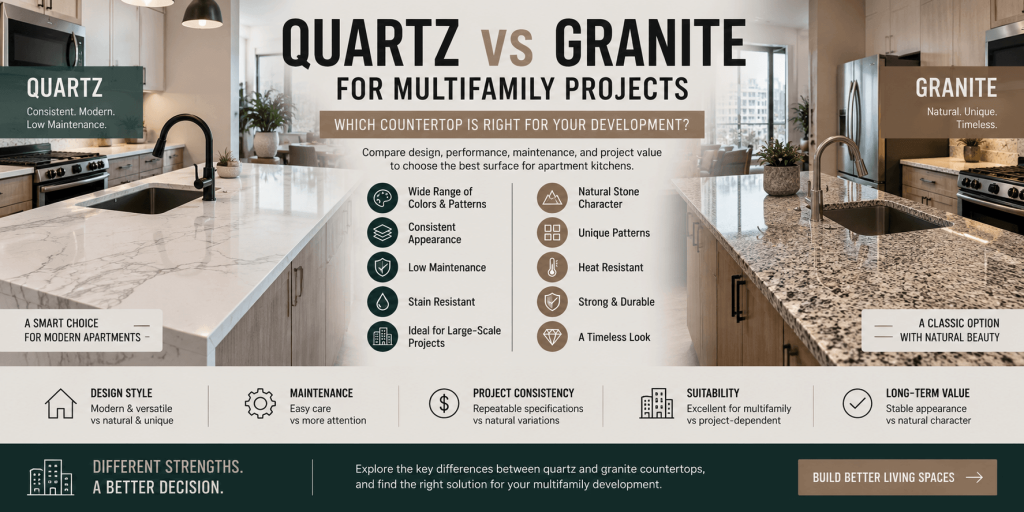
Quartz vs Granite: The Basic Difference
Quartz and granite are both widely used countertop materials, but they have fundamentally different characteristics.
Quartz is an engineered surface produced using mineral materials combined with other components to create a controlled and consistent product.
Granite is a natural stone formed by geological processes. Each slab can have its own natural pattern, color variation, and mineral composition.
This fundamental difference affects how the two materials are selected for large-scale residential developments.
1. Design Consistency
For multifamily developments, consistency can be extremely important.
A project may have:
- 50 apartment kitchens
- 100 bathroom vanities
- Multiple building phases
- Several unit types
- Standard and premium finish packages
The development team may want the countertops across similar units to look as consistent as possible.
Quartz
Quartz offers controlled patterns and colors, making it easier to establish a repeatable design specification.
This is particularly useful for:
- Standard apartment units
- Build-to-rent communities
- Large residential developments
- Multi-phase projects
Granite
Granite provides natural variation.
Two slabs from the same general material selection can have different:
- Veining
- Mineral patterns
- Color distribution
- Visual movement
This natural variation can be desirable from a design perspective, but it may make exact visual consistency more difficult.
For standardized multifamily projects:
Quartz generally has the advantage.
2. Design Appearance
The visual difference between quartz and granite is one of the most important factors for designers.
Quartz
Quartz can be produced in a wide range of styles, including:
- Solid colors
- Subtle patterns
- Marble-look designs
- Concrete-inspired surfaces
- Contemporary stone patterns
This gives designers significant flexibility when creating apartment finish packages.
Granite
Granite offers authentic natural-stone character.
Its appearance may include:
- Dramatic movement
- Natural mineral patterns
- Distinctive color variation
- Unique slab characteristics
For projects where natural stone character is a central part of the design concept, granite can be an attractive option.
3. Maintenance
Maintenance becomes especially important in multifamily housing.
Apartment kitchens and bathrooms are used every day, and property managers may eventually need to prepare units for new residents.
Quartz is generally considered a relatively low-maintenance countertop material.
Routine cleaning can usually be handled using standard household care.
Granite can also provide a durable countertop surface, but natural stone may require more attention depending on the specific stone and finish.
For developers managing large residential portfolios, minimizing unnecessary maintenance complexity can be valuable.
Multifamily consideration:
Quartz often provides a simpler maintenance strategy.
4. Everyday Apartment Use
Apartment kitchens experience regular residential activity:
- Food preparation
- Cooking
- Beverage preparation
- Spills
- Cleaning
- Everyday household use
Both quartz and granite can perform well when properly selected and maintained.
However, the more important question for a multifamily project is often:
How consistently can the material perform and be maintained across many units?
Quartz’s standardized composition and controlled production can make it attractive for large-scale developments.
Granite’s natural characteristics can vary from slab to slab.
5. Heat Resistance
Granite is well known for its ability to tolerate heat.
This can be useful in kitchen environments where hot cookware may occasionally come into contact with the countertop.
Quartz also performs well in everyday kitchen applications, but manufacturers typically recommend using appropriate protection when placing very hot cookware on the surface.
For apartment kitchens, the important consideration is not simply which material has better heat resistance, but how the countertop will be used and maintained by residents.
6. Stain Resistance and Cleaning
Kitchen countertops are exposed to food, beverages, oils, and cleaning products.
Quartz is commonly selected for multifamily kitchens because its non-porous surface is relatively resistant to everyday staining and straightforward to clean.
Granite is a natural stone with varying characteristics depending on the specific material.
Some granite surfaces may require sealing and periodic maintenance to help manage staining and moisture absorption.
For property managers seeking a simple maintenance strategy across many apartments, quartz can therefore be attractive.
7. Procurement and Standardization
This is where the comparison becomes particularly important for developers.
A multifamily project may need the same countertop specification repeatedly.
The project team may need to coordinate:
- Approved color
- Material selection
- Thickness
- Edge profile
- Fabrication
- Packaging
- Delivery
- Installation
Quartz is well suited to standardized specifications because the material is manufactured under controlled conditions.
Granite requires the project team to work with natural slabs that can vary visually.
This does not make granite unsuitable for multifamily projects—it simply creates a different procurement process.
8. Replacement and Future Renovation
Long-term property management should also be considered.
Apartment developments may eventually require:
- Countertop repairs
- Unit renovations
- Replacement pieces
- Kitchen upgrades
- Bathroom renovations
When the original countertop specification is based on a consistent engineered material, sourcing a matching or coordinated material can be more straightforward.
Natural granite can be more challenging to match exactly because individual slabs have unique characteristics.
For large property portfolios, this can be an important consideration.
9. Quartz vs Granite for Different Multifamily Applications
Not every part of a multifamily development needs the same material.
Standard Apartment Kitchens
Quartz is often a strong choice when consistency, low maintenance, and design flexibility are priorities.
Premium Apartment Kitchens
Both quartz and granite can work well.
Quartz can provide sophisticated marble-look or stone-inspired designs, while granite offers authentic natural-stone character.
Apartment Bathroom Vanities
Quartz is particularly practical when developers want a coordinated finish across multiple bathrooms.
Granite can also be used where natural stone aesthetics are preferred.
Clubhouses and Amenity Spaces
Either material may work depending on the interior design concept.
More distinctive granite may be appropriate for feature areas, while quartz can provide greater control over a standardized design language.
Quartz vs Granite: Multifamily Comparison
| Factor | Quartz | Granite |
|---|---|---|
| Material type | Engineered | Natural stone |
| Appearance consistency | High | Natural variation |
| Design selection | Wide | Material-dependent |
| Maintenance | Low | Moderate |
| Everyday kitchen use | Excellent | Excellent |
| Stain resistance | Excellent | Varies by stone and finish |
| Heat resistance | Good with proper care | Excellent |
| Standardization | Excellent | More challenging |
| Repeat specification | Easier | More variable |
| Natural character | Stone-inspired | Authentic natural stone |
| Multifamily suitability | Excellent | Good |
Which Is Better for Multifamily Developments?
There is no universal winner.
Instead, the better material depends on what the development prioritizes.
Quartz Is Particularly Suitable When:
- Multiple units need consistent finishes
- The project uses standardized specifications
- Low maintenance is important
- Designers need a wide range of controlled styles
- Procurement needs repeatable materials
- Future replacement is a consideration
Granite May Be Preferred When:
- Natural stone character is important
- Each space can accommodate natural variation
- A more traditional luxury aesthetic is desired
- The design intentionally celebrates unique slabs
Quartz vs Granite for Build-to-Rent Communities
Build-to-rent developments deserve special consideration.
Unlike traditional home sales, build-to-rent properties remain under centralized ownership or management.
This means the property owner may care about:
- Long-term maintenance
- Unit turnover
- Consistent appearance
- Standardized specifications
- Future renovation
- Portfolio-wide design
Quartz can be particularly attractive in this environment because the material lends itself well to repeatable specifications.
Quartz vs Granite for Apartment Developers
For developers, the decision should be evaluated from a project perspective rather than from a single-kitchen perspective.
A countertop that looks excellent in one apartment may not necessarily be the easiest choice for a development containing hundreds of units.
The project team should consider:
Design → Specification → Procurement → Fabrication → Installation → Maintenance → Replacement
Quartz can perform particularly well within this complete project cycle because it provides a controlled and repeatable material system.
How to Choose Between Quartz and Granite
Before finalizing the countertop specification, developers should ask:
1. How many units are involved?
The larger the development, the more important consistency becomes.
2. Do all units need the same finish?
If yes, quartz may provide a simpler specification.
3. Is natural variation desirable?
If the design concept celebrates natural stone variation, granite may be attractive.
4. How important is low maintenance?
For rental properties and large portfolios, this can strongly influence the decision.
5. Will the material need to be sourced again?
Future renovation and replacement should be considered during initial specification.
Conclusion
When comparing quartz vs granite countertops for multifamily projects, the decision goes far beyond appearance.
Granite offers authentic natural-stone character, unique patterns, and strong kitchen performance.
Quartz provides greater consistency, controlled design options, low-maintenance care, and a practical approach to standardized multifamily specifications.
For large apartment developments, build-to-rent communities, and rental properties where repeatability and property management are important, quartz is often the more straightforward choice.
For projects that place greater emphasis on natural stone variation and individual character, granite remains a compelling option.
Ultimately, the best countertop material is the one that aligns with the development’s design strategy, operational requirements, procurement model, and long-term property goals.
Related Resources
- Best Countertop Materials for Multifamily & Apartment Projects
- Why Quartz Countertops Are Ideal for Multifamily Developments
- Quartz Countertops for Apartment Kitchens: Durability & Style Guide
- Quartz Countertops for Commercial Projects: Performance & Design Guide
- Quartz Slabs Explained: Sizes, Thickness & Fabrication Options
FAQ
Is quartz or granite better for multifamily projects?
Neither material is universally better. Quartz is often more suitable when consistency, low maintenance, and repeatable specifications are priorities, while granite can be attractive when natural stone variation is part of the design concept.
Why do apartment developers choose quartz countertops?
Developers often choose quartz because it offers consistent appearance, a wide range of designs, low-maintenance care, and easier standardization across multiple apartment units.
Is granite suitable for apartment kitchens?
Yes. Granite can be used for apartment kitchens, particularly in projects where natural stone character and variation are desirable.
Is quartz easier to maintain than granite?
Quartz is generally easier to maintain because it does not typically require the same sealing considerations associated with some natural stone surfaces.
Which material is more consistent across multiple apartment units?
Quartz generally provides greater visual consistency because it is an engineered material manufactured to controlled specifications. Granite naturally varies from slab to slab.
Can quartz and granite both be used in the same multifamily development?
Yes. A project can use quartz in standardized apartment kitchens while using granite selectively in premium units, model apartments, or amenity spaces.
Which is better for rental properties, quartz or granite?
Quartz is often attractive for rental properties because low-maintenance care and standardized specifications can simplify property management across multiple units.
What should developers consider when comparing quartz and granite?
Developers should consider design consistency, maintenance, project scale, material availability, fabrication, procurement, future replacement, and the overall design strategy of the development.