
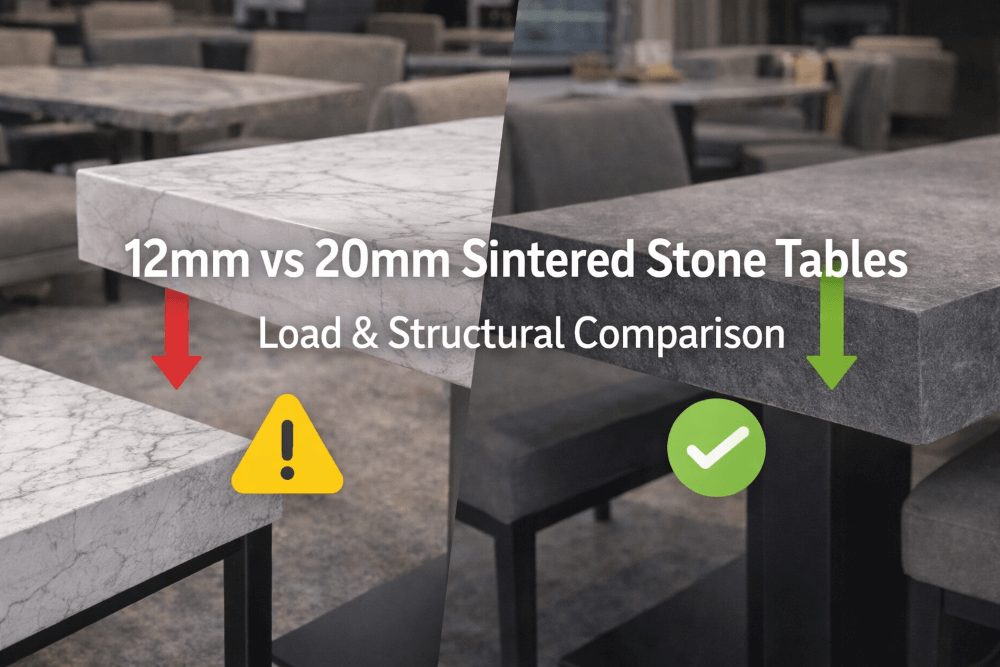
12mm vs 20mm Sintered Stone Tables: Load & Structural Comparison
Choosing the correct thickness is one of the most critical decisions when designing custom sintered stone tables for commercial use. Among all available options, 12mm and 20mm are the two most commonly specified thicknesses, yet they perform very differently under load.
This article provides a clear engineering-based comparison of 12mm vs 20mm sintered stone tables, focusing on load performance, structural behavior, and real-world commercial applications.
Why Thickness Matters in Commercial Sintered Stone Tables
In commercial environments such as restaurants, hotels, cafés, and public spaces, tables are exposed to:
Continuous daily use
Heavy tableware and equipment
Large tabletop spans
Frequent movement and impact
Incorrect thickness selection can lead to:
Excessive deflection
Cracking or edge failure
Long-term structural instability
Thickness is not an aesthetic decision — it is a structural one.
Understanding Load Behavior in Sintered Stone Tables
Sintered stone has high compressive strength, but like all slab materials, it behaves differently depending on:
Thickness
Span length
Support configuration
Base design
As tabletop size increases, bending stress increases exponentially, making thickness selection critical.
12mm Sintered Stone Tables: When Are They Suitable?
Typical Applications for 12mm
Small café tables
Tables with dense support structures
Short span lengths
Decorative or low-load environments
Structural Characteristics
Lighter weight
Cleaner, minimalist appearance
Requires proper base support
12mm sintered stone tables perform well only when structural conditions are controlled.
Important note:
Using 12mm slabs without adequate base design is one of the most common causes of table failure in commercial projects.
20mm Sintered Stone Tables: When Is It Necessary?
Typical Applications for 20mm
Large restaurant tables
Communal tables
Hotel lounge and lobby tables
High-traffic commercial environments
Structural Advantages
Higher bending resistance
Improved load distribution
Better impact resistance
Greater tolerance for wider spans
20mm thickness significantly reduces the risk of long-term deformation and cracking.
 Custom Sintered Stone Tables: Sizes, Thickness, Edges & Metal Bases
Load Performance Comparison: 12mm vs 20mm
| Performance Factor | 12mm | 20mm |
|---|---|---|
| Load capacity | Moderate | High |
| Span tolerance | Limited | Wide |
| Deflection risk | Higher | Lower |
| Impact resistance | Moderate | High |
| Suitable for large tables | Limited | Yes |
From an engineering perspective, 20mm provides a much wider safety margin for commercial use.
How Table Size Affects Thickness Selection
Thickness must always be evaluated together with table size.
General Guidelines
Small tables (≤700 mm width): 12mm may be acceptable
Medium tables (700–1600 mm): depends on base design
Large tables (≥1600 mm): 20mm strongly recommended
Ignoring table size is a common mistake that leads to premature failure.
The Role of Metal Base Design
Thickness alone does not guarantee performance.
A well-designed metal base:
Reduces unsupported span
Distributes loads evenly
Minimizes stress concentration
Conversely, a weak base can cause failure even with 20mm slabs.

Common Engineering Mistakes to Avoid
Using 12mm slabs for large unsupported spans
Ignoring deflection under long-term load
Treating thickness as a purely aesthetic choice
Pairing thin slabs with unstable table bases
These mistakes are common in projects without proper engineering evaluation.
Which Thickness Is Better for Commercial Projects?
For most commercial sintered stone tables, 20mm thickness offers:
Higher structural reliability
Longer service life
Lower risk of failure
Greater design flexibility
12mm can be used successfully, but only with strict structural control.
Conclusion
When comparing 12mm vs 20mm sintered stone tables, thickness selection should always be based on load performance, table size, and base design. While 12mm slabs may be suitable for smaller tables, 20mm thickness provides superior structural stability and is the safer choice for most commercial environments.
Correct thickness selection is a key factor in delivering durable, long-lasting sintered stone tables for commercial projects. Choosing the right thickness depends on your table structure and usage. Milestone International offer both options as a professional sintered stone table top supplier for commercial furniture.
FAQ
Is 12mm sintered stone strong enough for commercial tables?
Yes, but only for small tables with proper base support.
Why is 20mm recommended for large tables?
Because it offers higher bending resistance and better load distribution.
Can metal bases compensate for thinner slabs?
Partially. A good base helps, but it cannot fully replace proper thickness selection.
Does thicker sintered stone mean better durability?
Generally yes, especially for high-traffic commercial environments.
Is thickness selection purely a design decision?
No. It is primarily a structural and engineering decision.