
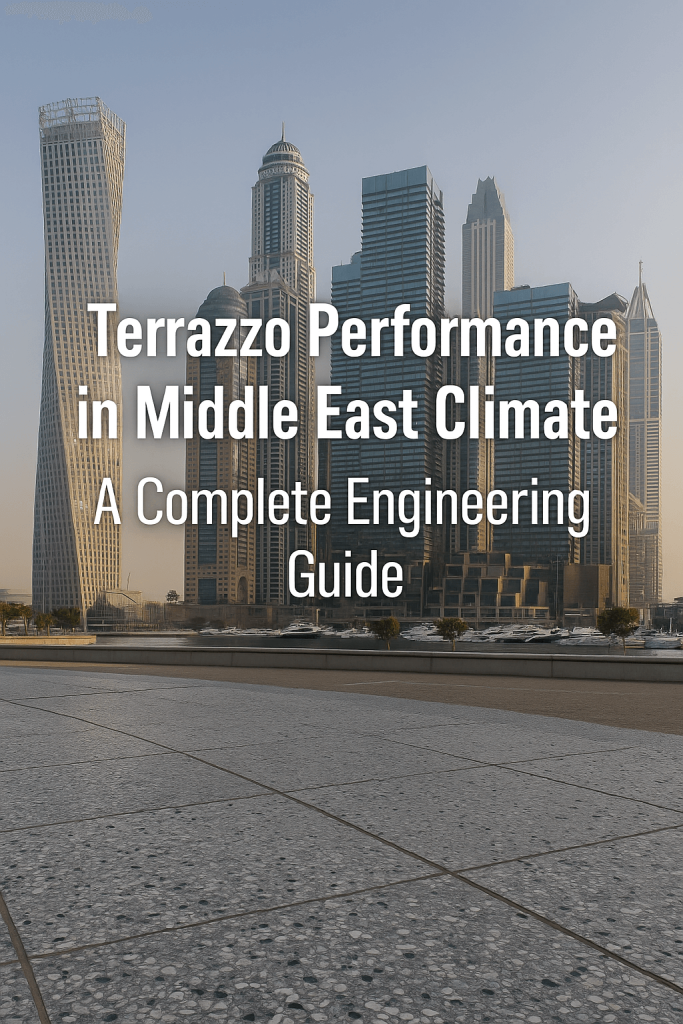
Terrazzo Performance in Middle East Climate: A Complete Engineering Guide
The Middle East presents some of the world’s most challenging environmental conditions for construction materials—extreme heat, intense UV exposure, thermal shock from air-conditioning, dust, humidity, and occasional rainstorms.
For developers, architects, and contractors working in UAE, Saudi Arabia, Qatar, Oman, Kuwait, Bahrain, Egypt, and Jordan, choosing the right surface material is critical for long-term performance and reduced maintenance costs.
This guide explains why terrazzo—especially cement-based terrazzo—is one of the most durable and reliable materials for both indoor and outdoor applications across the Middle East.
Why Terrazzo Performs Exceptionally Well in Middle East Environments
1. High Heat Resistance
Middle East summer temperatures regularly exceed 45–55°C, with surface temperatures going even higher.
Terrazzo Advantages
Cement-based terrazzo withstands 45–65°C without warping or discoloration
Low thermal expansion
Stable even under partial shade and direct sun
Suitable for outdoor plazas, walkways, and semi-outdoor hotel/mall spaces
Epoxy terrazzo performs extremely well indoors but should not be used outdoors due to resin UV sensitivity.
2. Superior UV Stability
Cement Terrazzo
Excellent UV resistance
Color remains stable even under long-term sunlight exposure
Ideal for:
Mall entrances
Shaded walkways
Hotel drop-off areas
Outdoor retail zones
Epoxy Terrazzo
Best used indoors only
May fade or yellow under direct UV
3. Thermal Shock Performance
Commercial buildings in the Middle East operate strong air-conditioning systems, causing rapid temperature changes.
Terrazzo:
Withstands sudden cooling
Prevents cracking and delamination
Performs better than marble and porcelain under thermal shock
This makes terrazzo excellent for airports, malls, and hotel interiors.
4. Moisture, Dust & Sand Resistance
The region’s environment includes:
High humidity (coastal cities like Dubai, Doha, Jeddah)
Frequent dust and sand storms
Occasional rain and condensation
Terrazzo Benefits
Dense, low-porosity surface (especially epoxy terrazzo)
Resistant to dust accumulation
Easy to clean and maintain
No swelling or warping
Comparing Cement Terrazzo vs Epoxy Terrazzo for Middle East Projects

| Feature | Cement Terrazzo | Epoxy Terrazzo |
|---|
| Flexural Strength | High | Very High |
| Outdoor Capability | Excellent | Not recommended |
| UV Behavior | UV stable | Fades under UV |
| Ideal Applications | Outdoor plazas, hotel walkways | Indoor malls, airports |
| Thickness | 40–100mm | 7–9mm |
| Weight | Heavy | Light |
Recommended Terrazzo Applications in Middle East Projects
 Outdoor & Semi-Outdoor Areas
 Outdoor & Semi-Outdoor Areas
Hotel drop-off zones
Landscape walkways
Mall entrances
Public plazas
Retail boulevard zones
Government building external corridors
Use cement-based terrazzo.
Heavy-Traffic Indoor Areas
Airport terminals
Mall corridors
Hotel lobbies
Metro stations
Museums and public buildings
Use epoxy terrazzo or precast terrazzo panels.
✔ Feature Walls & Interior Surfaces
Hotel receptions
Restaurant interiors
Luxury retail
Office lobbies
Use epoxy terrazzo or large precast panels.
Heat & UV Recommendations for Middle East Architects and Contractors
1. Choose Light-Colored Terrazzo for Heat Reduction
Reflects heat
Reduces surface temperature
Slows UV aging
2. Prefer Cement Terrazzo for All Outdoor Areas
Highest UV resistance
Longest life cycle
Minimal color fade
3. Avoid Epoxy Terrazzo Outdoors
Resin yellows under UV
Not suitable for direct sun
4. Use Proper Sealers
Increases stain resistance
Protects from sand abrasion
Enhances longevity
Installation Notes for Middle East Conditions
✔ Key Technical Considerations
Ensure substrate moisture barrier
Choose UV-stable pigments
Allow proper expansion joints
Use anti-slip finish in outdoor areas
Apply high-performance sealer
✔ Why Precast Panels Work Well
Faster installation
Perfect consistency
Less curing time
Ideal for mall renovation schedules
Conclusion
The Middle East’s extreme climate requires construction materials that can withstand heat, UV exposure, humidity, dust, and intense foot traffic.
Terrazzo—especially cement-based terrazzo—outperforms marble, porcelain, and engineered stone in key durability metrics, making it an ideal material for hotels, malls, airports, and public infrastructure projects.
Milestone International manufactures customizable terrazzo slabs and precast panels engineered specifically for Middle East commercial environments. Contact us for project specifications, samples, and technical assistance.